About CO 2 And Temperature Sensor Supplier
CO 2 And Temperature Sensor:
Our domain expertise has enabled us to come up with quality CO2 And Temperature Sensor. The products we offer are designed and engineered under the notable guidance of our diligent professionals. Furthermore, our products are timely delivered at clients disposal, with the assistance of wide distribution network.
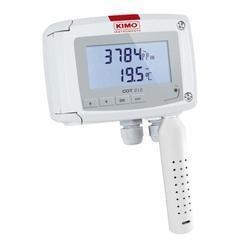
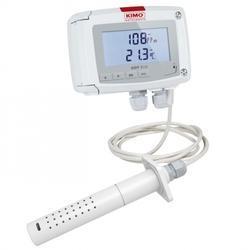
Temperature and CO2 sensor
Kimo's COT 212-R measures CO2 from 0 to 20,000 ppm and temperature from 0 to 50oC.
Salient Features :
- Measuring range measures CO2 from 0 to 20,000 ppm and temperature from 0 to 50oC
- With or without 2-line 19-digits LCD display
- Two relays
- 0-5/10 V or 0/4-20 mA outputs
- Quick and easy mounting with the 1/4 turn system with wall-mount plate
- Adjustment certificate
Technical details :
| Temperature |
| Sensor | Min | Max |
| NTC | 0.00 C | 50.00 C |
| CO2 |
| Sensor | Min | Max |
| CO2 | 0.00 ppm | 5000.00 ppm |
Technical details :
| Parameters | CO2 Temperature |
| Displays | No 2-line display |
| IP Protection | IP 65 |
| Standards | 2011/65/EU RoHS II
2012/19/EU WEEE
2014/30/EU EMC
2014/35/EU Low Voltage |
| Power supply | 24 Vac/Vdc or 100-240 Vac |
| Outputs | 2 x 4-20 mA or 2 x 0-20 mA or 2 x 0-5 V or 2 x 0-10 V (4 wires) |
| Relay | 2 changeover relays 3 A / 230 V |
| Ethernet communication | No |
| Modbus network | No |
Instrument Dimensions :
| Length | Width | Height | Weight |
| 125.00 mm | 59.20 mm | 202.00 mm | 240.00 g |
| Operating temperature |
| Min | Max |
| -10.00 oC | 50.00 oC |
| Storage temperature |
| Min | Max |
| -10.00oC | 70.00oC |
Supplied with :
- 1 ABS plate (expect ambiant model)
Stable and Accurate ReadingsUtilizing NDIR (Non-Dispersive Infrared) principles, the sensor ensures accurate CO2 detection (3%) along with precise temperature monitoring (0.5C). Its broad measurement range and rapid response time make it reliable for real-time monitoring in indoor air quality, HVAC systems, and industrial safety applications.
Seamless Integration and Low MaintenanceThe compact dimensions and PCB mount design allow effortless integration into existing electronic assemblies. With a warm-up time of just 30 seconds and minimal power draw, installation is straightforward, and the sensor requires virtually no regular maintenance, providing a cost-effective and robust solution for businesses.
FAQs of CO 2 And Temperature Sensor Supplier:
Q: How is the CO2 concentration measured by this sensor?
A: The sensor employs Non-Dispersive Infrared (NDIR) technology to measure CO2 levels, providing accurate readings across a range of 400 ppm to 5000 ppm by detecting the infrared absorption properties of carbon dioxide gas.
Q: What is the typical installation process for this CO2 and temperature sensor?
A: Installation is simple due to its PCB mount form factor. The sensor can be soldered directly onto circuit boards and interfaced via analog (0.4 V to 2 V) or digital UART output to compatible microcontrollers or monitoring systems using a 5V DC power supply.
Q: When should I consider replacing the sensor?
A: The CO2 and temperature sensor is designed with a lifespan of over five years. Replacement is generally recommended after this period or if you notice a significant drop in measurement accuracy or response time.
Q: Where can this sensor be effectively used?
A: This sensor is ideal for applications such as indoor air quality assessment, environmental monitoring, HVAC systems, and industrial process control. With its wide measurement and operating ranges, it can be used in laboratories, offices, factories, and educational institutions across India.
Q: What are the benefits of using this sensor in my application?
A: You benefit from high measurement accuracy, a robust build, and flexibility in output signalssupporting both analog and UART digital communication. Its low power consumption and minimal maintenance requirements make it an economical choice for long-term deployment.
Q: How quickly does the sensor provide updated readings?
A: The sensor has a response time of less than 120 seconds, ensuring timely and reliable data for dynamic monitoring environments.
Q: What should I consider for optimal sensor performance?
A: Ensure the sensor operates within its specified temperature (0C to 50C) and humidity (0% to 95% RH, non-condensing) ranges. Avoid exposing it to conditions beyond storage limits or to the presence of liquids to maintain measurement integrity and extend its service life.

 Send Inquiry



 Send Inquiry

 Send Inquiry