About Pressure And Temperature Sensor Suppliers
Pressure And Temperature Sensor:
Our domain expertise has enabled us to come up with quality Pressure And Temperature Sensor. The products we offer are designed and engineered under the notable guidance of our diligent professionals. Furthermore, our products are timely delivered at clients disposal, with the assistance of wide distribution network.
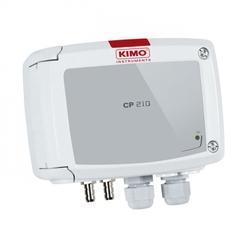
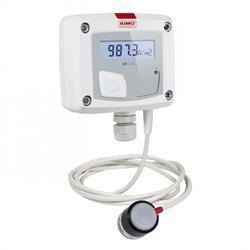
Kimos CP 210-R measures air velocity, airflow & pressure and is ideal for use in industrial and pharmaceutical applications.
Salient Features :
- Measuring range: CP 211: -100 to +100 Pa, CP 212: -1,000 to +1,000 Pa, and CP 213: -10,000 to +10,000 Pa
- Solenoid valve for auto-calibration (CP211/212)
- 0-5/10 V or 0/4-20 mA outputs
- Two relays
- Automatic autozero
- Quick and easy mounting with the 1/4 turn system with wall-mount plate
Technical details :
| CP 211 |
| Sensor | Min | Max |
| Differential pressure | -100.00 Pa | 100.00 Pa |
| CP 212 |
| Sensor | Min | Max |
| Differential pressure | -1000.00 Pa | 1000.00 Pa |
| CP 213 |
| Sensor | Min | Max |
| Differential pressure | -10000.00 Pa | 10000.00 Pa |
Technical details :
| Parameters | Differential pressure Temperature |
| Displays No 2-line display |
|
| IP Protection | IP 65 |
| Standards | 2011/65/EU RoHS II
2012/19/EU WEEE
2014/30/EU EMC
2014/35/EU Low Voltage |
| Power supply | 24 Vac/Vdc ou 100-240 Vac |
| Outputs | 2 x 4-20 mA or 2 x 0-20 mA or 2 x 0-5 V or 2 x 0-10 V (4 fils) |
| Relay | 2 RCR relay 3A/230 Vac |
| Ethernet communication | No |
| Modbus network | No |
Instrument Dimensions :
| Length | Width | Height | Weight |
| 125.00 mm | 59.20 mm | 115.00 mm | 340.00 g |
| Operating temperature |
| Min | Max |
| -10.00 oC | 50.00 oC |
| Storage temperature |
| Min | Max |
| -10.00 oC | 70.00 oC |
Supplied with
- 1 ABS plate (expect ambiant model)
Versatile Measurement CapabilitiesDesigned to handle a variety of mediums, including air, gas, and liquid, these sensors support diverse industrial applications. Their wide pressure range (0 to 100 bar) and stainless steel construction ensure both flexibility and resilience, making them suitable for harsh operating environments.
Reliable and Fast PerformanceWith a response time of less than 2 ms and high accuracy (1% FS), operators can rely on these sensors for quick, precise data integration in process control or automation systems. The robust design ensures a sensor life of over 5 million cycles, reducing maintenance costs and downtime.
Easy Installation and ConnectivityEquipped with threaded mounting and both M12 and cable connector options, these sensors integrate smoothly into existing configurations. Their IP65 protection and compact size (approx. 80 g) make them a practical choice for OEMs, system integrators, and maintenance teams alike.
FAQs of Pressure And Temperature Sensor Suppliers:
Q: How are these pressure and temperature sensors installed in industrial systems?
A: These sensors use a threaded mounting type, allowing secure and leak-proof installation in pipelines or equipment. The connectors, available as either M12 or cable, enable straightforward and reliable connectivity with control systems.
Q: What benefits do the IP65 ingress protection and stainless steel material provide?
A: IP65 ingress protection shields the sensor from dust and water jets, making it suitable for harsh environments. The stainless steel construction enhances durability, corrosion resistance, and longevity under demanding operating conditions.
Q: Where can these sensors be used in India?
A: These pressure and temperature sensors are widely used across India in industrial automation, HVAC systems, and process control environments. They are available through authorized suppliers, dealers, exporters, and retailers nationwide.
Q: What is the accuracy and response time of the sensor?
A: The sensor boasts an accuracy of 1% full scale (FS) and a response time of less than 2 milliseconds, ensuring fast and dependable measurements required for dynamic and critical industrial applications.
Q: When should the sensors be replaced or maintained?
A: With a sensor life exceeding 5 million cycles, these units require minimal maintenance. Replacement is usually only needed after prolonged, intensive use or if the sensor shows signs of drift or mechanical damage.
Q: How do these sensors benefit process control and automation?
A: They provide precise, real-time measurements that facilitate enhanced process control, reduce manual intervention, and support automated decision-making, ultimately improving operational efficiency and safety.
Q: What process is involved in selecting the right sensor configuration?
A: Selection typically involves evaluating the required pressure range, operating conditions (such as temperature or medium type), mounting requirements, output specifications, and compatibility with existing control systems to ensure optimal performance.

 Send Inquiry



 Send Inquiry

 Send Inquiry