About Humidity And Temperature Sensor Suppliers
Humidity And Temperature Sensor:
Our domain expertise has enabled us to come up with quality Humidity And Temperature Sensor. The products we offer are designed and engineered under the notable guidance of our diligent professionals. Furthermore, our products are timely delivered at clients disposal, with the assistance of wide distribution network.
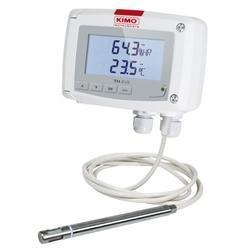
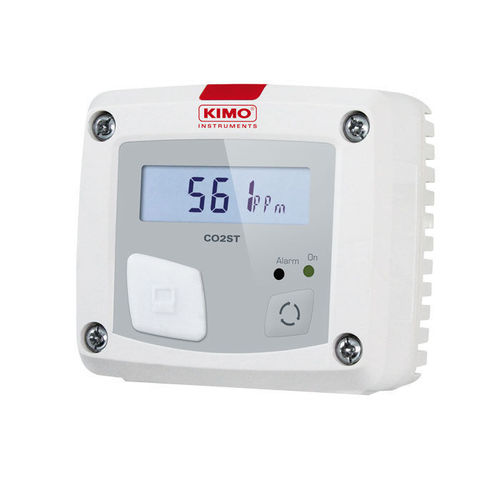
Kimo's TH 110 measured humidity and temperature from 5 to 95% RH and from 0 to 50oC.
Salient Features :
- Measuring range from 5 to 95% RH and from 0 to 50oC (ambient model) or from -20 to +80oC (duct or remote model)
- 0-10 V output or 4-20 mA output
- With or without 10-digits LCD display
- Housing with simplified mounting system
- Software or DIP switch configuration
- Quick and easy mounting with the 1/4 turn system with wall-mount plate
Technical details :
| Ambiant model |
| Sensor | Min | Max |
| Temperature | 0.00 oC | 50.00 oC |
| Humidity | 5.00 % RH | 95.00 % RH |
| Duct or remote model |
| Sensor | Min | Max |
| Temperature | -20.00 oC | 80.00 oC |
| Humidity | 5.00 % RH | 95.00 % RH |
Technical details :
| Parameters | Humidity Temperature |
| Displays | No 1-line display |
| Standards | 2011/65/EU RoHS II
2012/19/EU WEEE
2014/30/EU EMC
2014/35/EU Low Voltage |
| Power supply | 24 Vac/Vdc (Active) or 16/30 Vdc (Passive) |
| Outputs | 0-10 V (Active) or 4-20 mA (Passive) |
| Ethernet communication | No |
| Modbus network | No |
| Instrument Dimensions : |
| Length | Width | Height | Weight |
| 90.00 mm | 46.00 mm | 109.00 mm |
|
| Operating temperature |
| Min | Max |
| 0.00 oC | 50.00 oC |
| Storage temperature |
| Min | Max |
| -10.00 C | 70.00 oC |
Supplied with :
- 1 ABS plate (exept ambient model)
- 1 Data sheet
- 1 User manual
Wide Measurement Ranges for Critical ApplicationsThese sensors cover the entire spectrum of relative humidity (0%100% RH) and extreme temperatures from -40C up to +125C, making them ideal for use in harsh industrial, commercial, and environmental conditions. With rapid response and accurate readings, they help maintain optimal system performance across HVAC, weather stations, and automation setups.
High Stability and Fast Response for Reliable MonitoringFeaturing a responsive measurement speed of less than 8 seconds for humidity and long-term stability of 0.5% RH/year, these sensors ensure precise data over extended periods. Their robust polymer construction and compensable performance between 0C and +80C make them well-suited for continuous and demanding monitoring requirements.
Versatile Output and Interfaces for Seamless IntegrationAvailable in digital output formats and supporting I2C, 1-Wire, or analog communication, these humidity and temperature sensors provide flexible integration paths for diverse applications. Their standardized voltage ranges simplify connectivity, allowing easy use across different platforms and system architectures.
FAQs of Humidity And Temperature Sensor Suppliers:
Q: How are these humidity and temperature sensors used in industrial automation applications?
A: These sensors are integrated into industrial automation systems to monitor ambient conditions, ensure quality control, and optimize operational efficiency. Their fast response and high accuracy enable real-time data logging and environmental adjustments within production environments.
Q: What benefits do these sensors offer for HVAC systems?
A: In HVAC applications, they provide reliable measurement of humidity and temperature, allowing for precise climate control. The broad measurement range and robust stability help maintain comfortable and safe indoor environments while enhancing energy efficiency.
Q: Where can these sensors be installed for weather monitoring purposes?
A: These sensors are suitable for installation in weather stations, agricultural sites, or environmental monitoring equipment. Their durability and wide operating temperature range ensure they function efficiently outdoors, even in challenging weather conditions.
Q: What is the process of integrating these sensors with data loggers?
A: Integration typically involves connecting the sensor via the available interfacesuch as I2C, 1-Wire, or analogto the data loggers input. Once connected, the sensor outputs digital data, which the logger records and processes for analysis or reporting.
Q: When should these sensors be calibrated or serviced?
A: Thanks to their long-term stability of 0.5% RH/year, these sensors require minimal calibration, making them ideal for continuous use. Calibration or servicing may be necessary during scheduled maintenance or after long-term deployment to ensure ongoing accuracy.
Q: What communication interfaces are available for these sensors and how does that affect usage?
A: Models support I2C, 1-Wire, or analog interfaces, allowing them to be used with a variety of controllers and data logging systems. The choice of interface depends on the system requirements and desired mode of integration, enhancing application flexibility.

 Send Inquiry



 Send Inquiry

 Send Inquiry